| 24.30 Megapixels | Sony E | 35mm size sensor |
|---|---|---|
 | ||
 |  |  |  |  |
A7 II SUMMARY
Sony has yet another winner on their hands with the A7 II. By addressing some of the design and ergonomic quirks of the original model, as well as providing a notable technological achievement with their 5-axis image stabilization -- and some subtle, yet worthwhile, performance enhancements -- the Sony A7 II is a more matured, more well-rounded camera and therefore an even more enticing option for those wanting full-frame image quality but not a full-frame DSLR-sized camera.
PROS
Excellent 5-axis sensor-shift image stabilization; Sensor-shift IS brings stabilization to nearly any lens; Much-improved ergonomics and top-deck control layout; 'Mark II' maintains same impressive image quality, dynamic range and high ISO performance; XAVC S 50Mbps video format; Faster start-up time; Hybrid AF performs well with good continuous AF.
CONS
(Similar to A7): Loud shutter (but electronic first-curtain helps); Battery life could be better; Low-light AF still not as good as most DSLRs; High ISO JPEGs look over-processed; Slow buffer clearing; Limited selection of native Sony FE lenses (but it's getting better).
PRICE AND AVAILABILITY
The Sony A7 II originally began shipping in December 2014 in two configurations: body-only for about US$1,700, or in a kit bundled with the FE 28-70mm f/3.5-5.6 OSS zoom lens (model SEL2870) for about US$2,000.
IMAGING RESOURCE RATING
5.0 out of 5.0
Sony A7II Review
Updates:
U.S. pricing and availability announced: 11/26/2014
02/20/2015 -- Field Test04/03/2015 -- Image Quality Comparison & Print Quality
04/08/2015 -- Review Conclusion
U.S. pricing and availability announced: 11/26/2014
02/20/2015 -- Field Test04/03/2015 -- Image Quality Comparison & Print Quality
04/08/2015 -- Review Conclusion

Sony unveiled the latest addition to the A7-series of full-frame mirrorless cameras, the new Sony A7II this past November. The "Mark II" model features not only the world's first 5-axis sensor-shift image stabilization system for a full-frame ILC, but also a number of design tweaks and build quality improvements.
Originally seen on the Olympus E-M5, a 5-axis sensor-shift image stabilization system compensates for yaw, pitch, and roll, as well as vertical and horizontal motion. The Sony Japan website indicates that the new 5-axis system on the Sony A7II should provide up to 4.5 stops of stabilization correction. If you recall, Sony made a big investment into Olympus back in 2012, and using their partnership, it could be that Olympus' technology for body-based IS is making its way into Sony Alpha cameras. (Sony of course has also had body-based IS technology in some of their cameras for years, but the 5-axis aspect of this system is an advancement into an area where Olympus already had expertise.)
Interestingly, the A7M2's sensor-shift image stabilization works in concert with the Optical Steady Shot system built into OSS-equipped E-mount lenses, with the body compensating for roll, vertical and horizontal motion while the lens compensates for pitch and yaw, offering better correction than employing just the in-body stabilization. However, for Sony lenses (both A-mount and E-mount) without optical I.S., the camera will provide all the heavy-lifting with sensor-based stabilization (note: some A-mount lenses will only receive 3-axis I.S.) A further benfity is that on third-party lenses, which don't communicate electronically with the camera, users can manually input a focal length (8-1000mm) and thereby get the benefits of the sensor shift stabilization, as well.
Sony A7 II 5-axis SteadyShot INSIDE Image Stabilization Demo
|
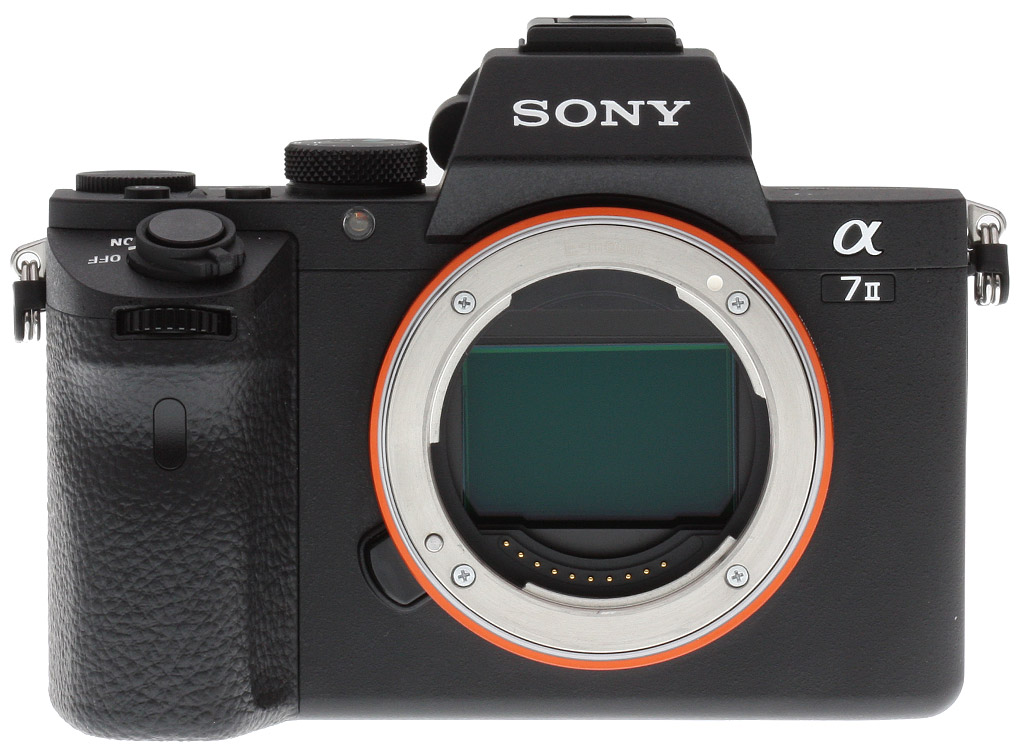
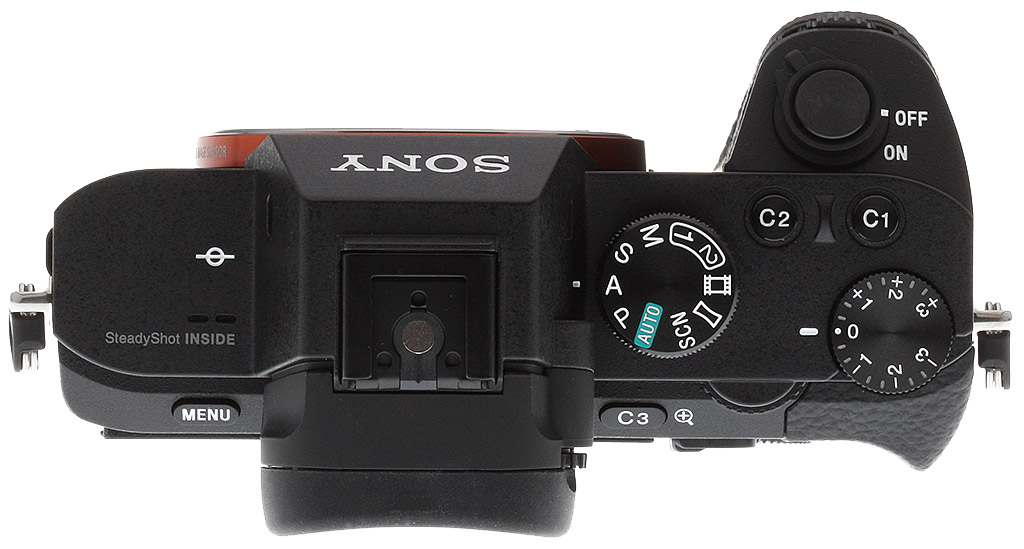
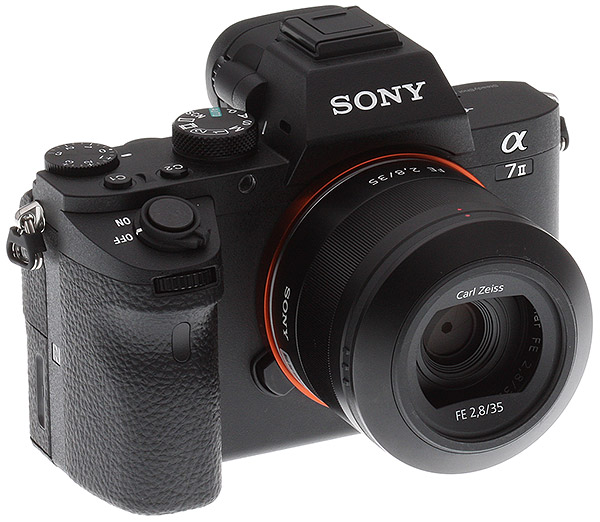
Other changes include an updated grip design, including moving the front sub-control dial into a more natural and convenient front-facing location as well as moving the shutter release button out on top of the grip area. This move has given Sony the space to add an additional "C2" custom function button up to the top deck. The custom function buttons are said to support 56 different function assignments for tremendous customizability. In fact, the functionality of the A7 II can be tweaked quite a bit to suit your shooting style, with the C1-3 custom function buttons, as well as the AEL, ISO, AF/MF, and control dial buttons all being programmable with up to 56 different function assignments.
 |
 |
The body design itself has also received a refresh, with what looks like a matte black speckled finish, a change from the clean, smooth semi-gloss black of the predecessor (and other A7-series models). The body construction is a full two-part magnesium alloy shell that's dust- and moisture-resistant, including weather seals on buttons and dials. The Sony A7II's lens mount has also been improved by using magnesium alloy to increase strength and rigidity, which can be especially helpful when using larger, longer, and heavier lenses.

The Sony A7 II's tiling LCD has also been upgraded to a White Magic panel, which has pixels comprised of red, green, blue and white dots to boost brightness, resulting in a dot count of 1,228,800 versus 921,600 dots for the prior models with RGB panels. The range of the tilting mechanism has also been improved, allowing the panel to tilt upwards to about 107 degrees, up from 84 degrees on the A7, though downward tilt is slightly more limited to about 41 degrees, versus 45 on the predecessor.
First seen on the Sony A7S, the new A7II also features improved video recording capabilities including XAVC S format at 50Mbps as well as an optional S-Log2 gamma profile for maximum dynamic range and more latitude for post production manipulation and grading. There is also time code support, clean HDMI output (up to 1080/60p output) with simultaneous internal recording, as well as uncompressed 4:2:2 8-bit output via HDMI into an external recorder. Video recording resolutions available in XAVC S format are: 1920 x 1080 at 60p, 30p and 24p, while AVCHD 2.0 format offers 1920 x 1080 at 60p, 60i and 24p. 1440 x 1080 and VGA resolutions at 30p are also available in MP4 format.
The Sony A7 II maintains the same 24.3-megapixel full-frame sensor as its predecessor, along with the Fast Hybrid AF system with the combination of 117 on-sensor phase detect points and 25 contrast detect AF points. This allows for up to 5fps burst shooting with continuous autofocus, like the A7 before it, however Sony says AF speed has been improved over its predecessor by some 30% while focus tracking accuracy has been improved by 1.5x through the use of new algorithms for detecting subject distance and predicting motion. Sony also claims the A7 II's startup time is about 40% faster than the A7.
Like its predecessor, the A7 II features both Wi-Fi and NFC wireless connectivity that allow for both wireless transfrer of images as well as remote control shooting, among other features using Sony's suite of PlayMemories Mobile apps for iOS and Android devices. Using a special "Lens Compensation" app, A7 II owners can manually adjust the amount of correction applied for various optical characteristics, such as vignetting, chromatic aberration and distortion.
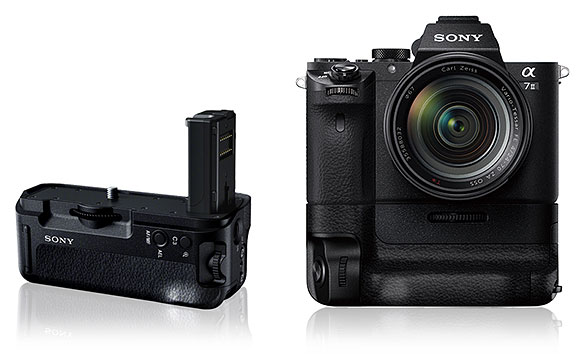
An optional VG-C2EM vertical battery grip that is dedicated to the A7 II is available, allowing a second NP-FW50 battery to double the A7 II's battery life. The A7 II uses the same rechargeable lithium ion battery pack as the original model, and storage is also similar: Secure Digital (SD, SDHC & SDXC) or Memory Stick (PRO Duo, PRO-HG Duo & XC-HG Duo) memory cards. Note: SDXC 64GB memory cards are required to shoot XAVC S format video. The Sony A7II originally began shipping in December 2014 in two configurations: body-only for about US$1,700, or in a kit bundled with the FE 28-70mm f/3.5-5.6 OSS zoom lens (model SEL2870) for about US$2,000. Sony has also introduced a soft carrying case for the A7 II (LCS-ELCB), as well as an FDA-EP15 soft eye-piece cup which is compatible with all Alpha 7 models.
[UPDATE 3/30/2015: To see images shot with the new 24-240mm FE lens go to our A7 II gallery page and scroll to the images with "24-240mm" in the filename.]
 Introduction. Despite some quirks -- slow startup, less-than-optimal ergonomics and limited native lens selection, for example -- the Sony A7-series has been a massive success thanks to outstanding image quality from its full-frame sensor and a small, lightweight form factor. I had a fantastic time reviewing the earlier Sony A7S, and, yet again, notwithstanding a few minor quibbles here and there, the overall experience was impressive. So when Sony surprised the photography world only a year later with the introduction of the second-generation A7 Mark II with built-in sensor-shift image stabilization, I jumped at the chance to shoot with this camera.
 Here we compare crops of our Still Life test shot target from the Sony A7 II to the Sony A7, Canon 6D, Fujifilm X-T1, Nikon D610 and Samsung NX1. All of these models sit at relatively similar price points and/or categories in their respective product lineups as advanced enthusiast or professional-level cameras.
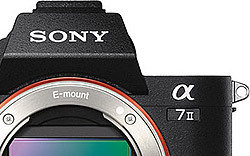 Sony is going all out with their full-frame mirrorless camera series; first with a high-res base model and an even higher-res model, and then with an ultra-low-light, 4K-capable model. Now, they've circled back around a year later to update the original, base-model A7. With the new A7 Mark II, Sony has kept the same imaging pipeline with a very good, high resolution 24.3-megapixel sensor and BIONZ X image processor, so basic image quality performance remains practically identical to its predecessor, which is to say, very good.
In the Box
The Sony A7 II body-only retail box (as reviewed) contains the following items:
- Sony A7 II camera body
- NP-FW50 Lithium-Ion Rechargeable Battery (1020mAh)
- AC-UUD11 AC Battery Charging Adapter
- Shoulder Strap
- Body Cap
- Multi-Interface Shoe Cover
- Eyepiece Cup
- Micro-USB Cable
The Sony A7 II is also offered in a kit configuration with the FE 28-70mm f/3.5-5.6 OSS lens, which includes all other items as listed in the body-only retail package above.
Recommended Accessories
- Large capacity SDHC/SDXC memory card. (SDXC memory card required for XAVC S video format.)
- Extra NP-FW50 Lithium-Ion Rechargeable Battery (~US$50)
- Sony Vertical Battery Grip for Alpha a7 II Digital Camera (~US$350)
- Sony HVL-F20M External Flash (~US$148)
- Small/Medium Carrying Bag
| Basic Specifications | |
|---|---|
| Full model name: | Sony Alpha ILCE-A7 II |
| Resolution: | 24.30 Megapixels |
| Sensor size: | 35mm (35.8mm x 23.9mm) |
| Kit Lens: | 2.50x zoom 28-70mm (28-70mm eq.) |
| Viewfinder: | EVF / LCD |
| Native ISO: | 100 - 25,600 |
| Extended ISO: | 50 - 51,200 |
| Shutter: | 1/8000 - 30 seconds |
| Max Aperture: | 3.5 (kit lens) |
| Dimensions: | 5.0 x 3.8 x 2.4 in. (127 x 96 x 60 mm) |
| Weight: | 32.8 oz (930 g) includes batteries, kit lens |
| Availability: | 12/2014 |
| Manufacturer: | Sony |
| Full specs: | Sony A7 II specifications |

No comments:
Post a Comment